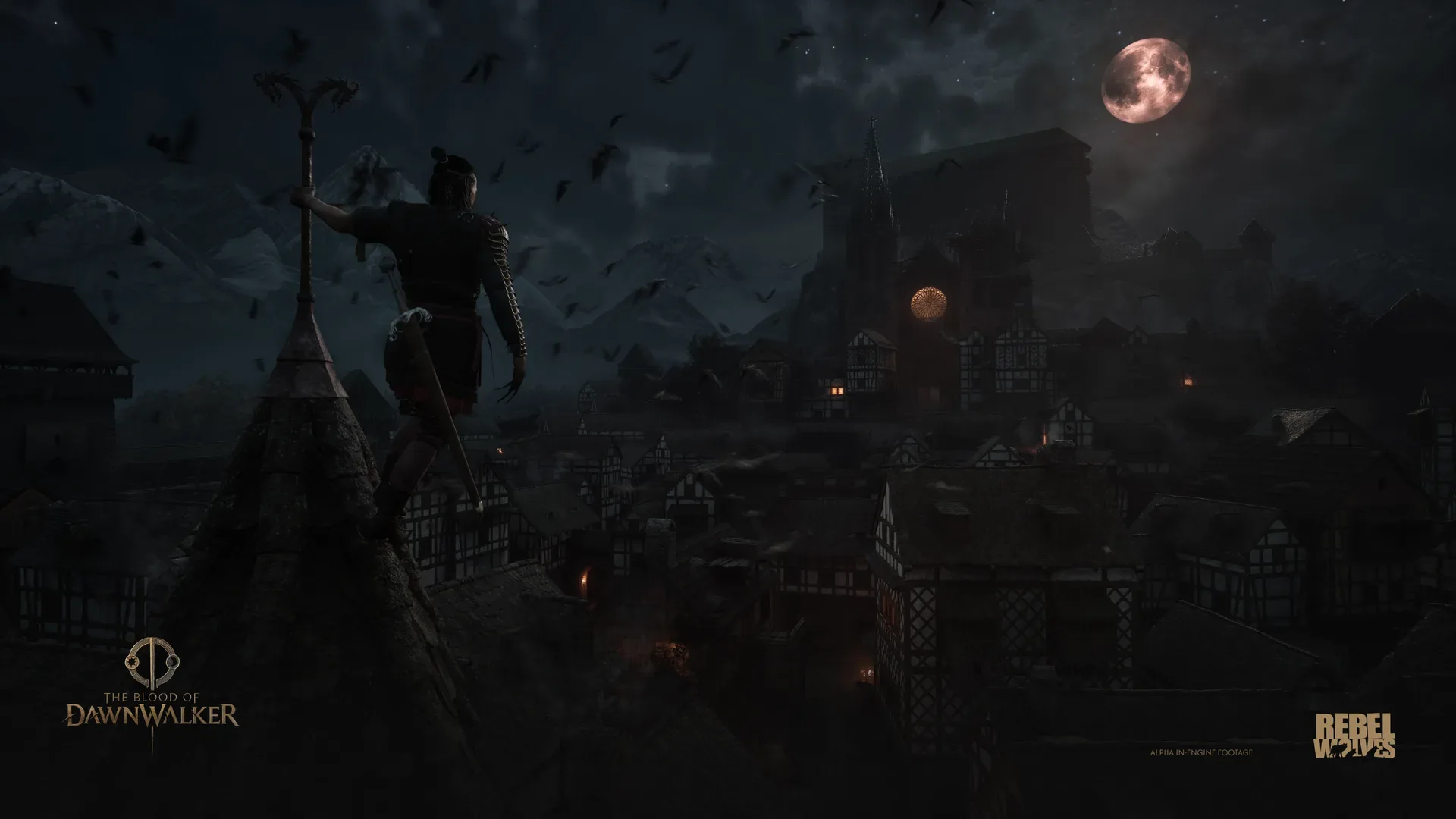
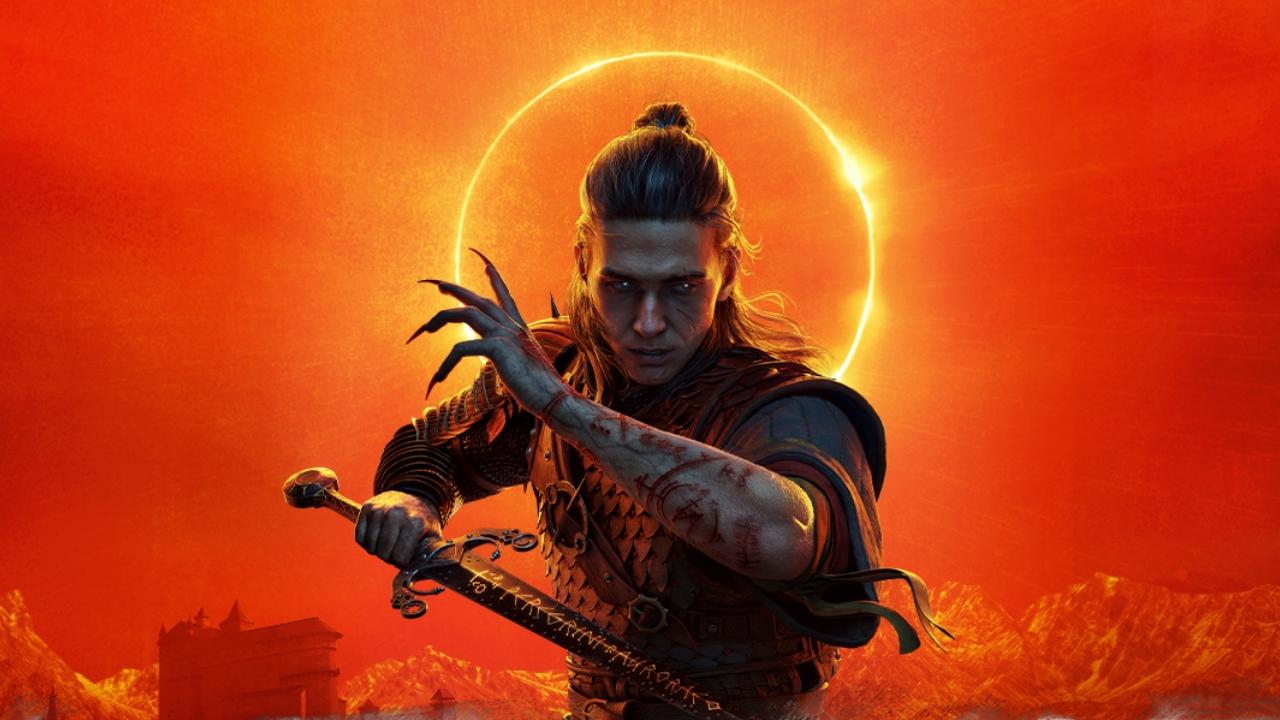
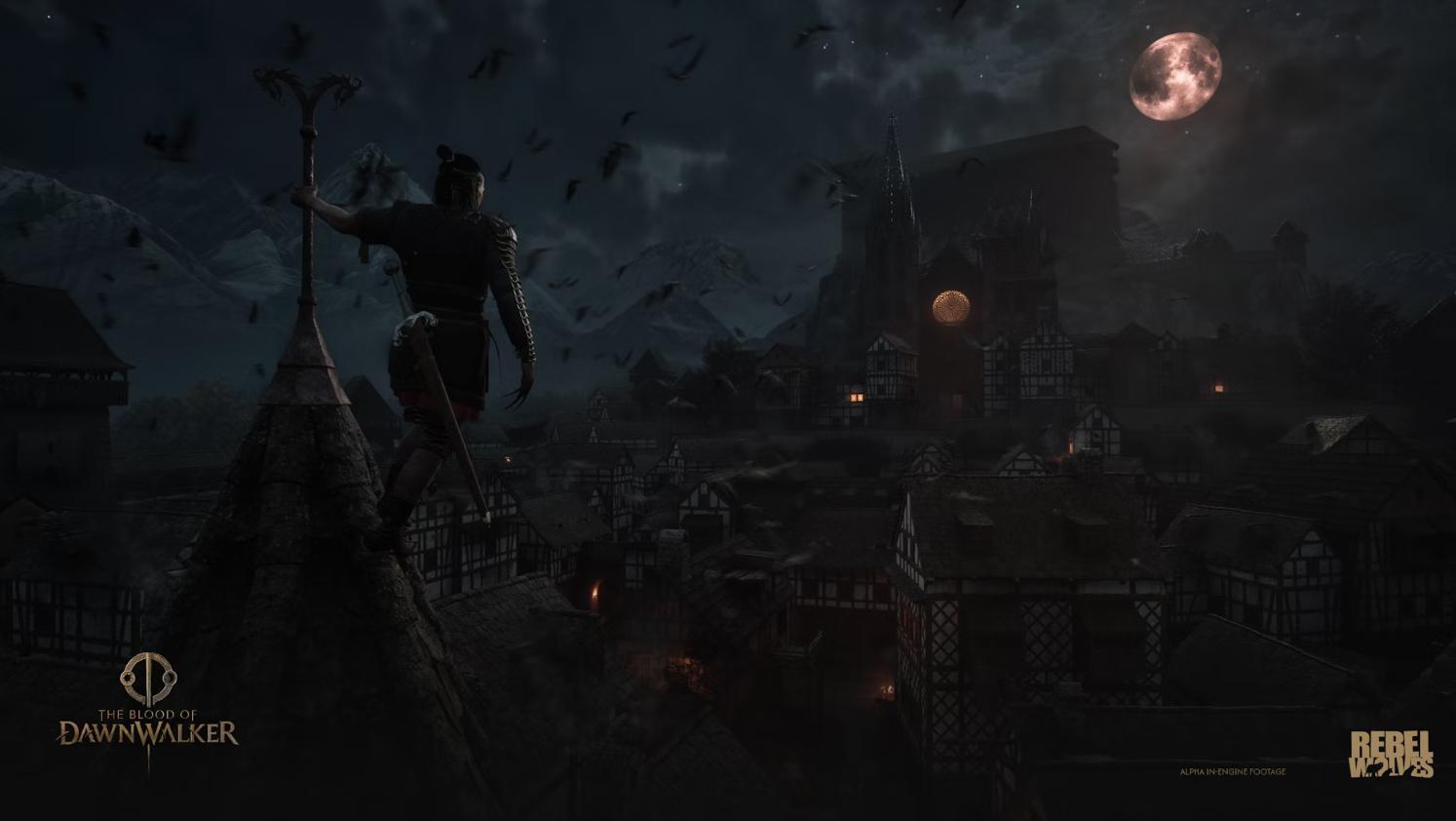
Gameplay Review: The Blood of Dawnwalker
 Reviewed by Youssef Elsawy
Played on PC, own copy, highest settings, latest build, on Challenging (the fourth of five difficulties). Finished at level 39, every ending.
Everyone told me about the thirty days. Nobody told me that the thirty days would stop mattering.
That is the sentence I keep coming back to after finishing The Blood of Dawnwalker, because for the first half of it I was convinced I was playing something rare. A game where the clock is not decoration. A game that says you cannot do all of this and means it. Then, somewhere around the point where my blood bar stopped being a problem and my health started refilling itself on its own, the clock became a number in the corner of the screen, and the game I had been playing turned into a different, softer one.
The clock is the best idea in the game
You have thirty days and thirty nights to save your family and your village. Day and night are separate forms with separate tool-kits, and most things you do cost time: questing, learning skills, upgrading skills. In the early hours it feels as though there is always more on the map than there is day left to spend.
What I did not expect was how honest the game is about that. The early hours hand you side quests and activities with an open door in the middle of them - you can start something, see what it costs, and walk away. You are not failing a checklist when you skip it. You are spending a currency that only exists once.
And it is not a fail state. Running out of time does not hand you a game over screen. It hands you consequences. That is a much braver design than a countdown.
I knew the stake before I installed the game, because the game told everyone: if the month runs out, your family dies. No game over, no retry from the last checkpoint. Thirty days of decisions, and then the people you were doing it for are gone. That is the promise I bought the game on, and it is why I was willing to forgive the first half almost anything.
The game makes you choose what to care about, and then it makes you live with the choice.
For about fifteen hours, that held. I was turning down side content because I wanted the main thread, and every refusal felt like it meant something.
Then the clock stops mattering
That is where the design starts to come apart, and it comes apart twice.
The first crack is the budget itself. I finished every quest on the map - every one, apart from a handful of the repetitive Court tasks I left alone once the Court's characters were done - and I still had five days left on the deadline.
Five days.
I want to be careful here, because this is the thing that upset me most, more than any boss fight or camera. The pitch of this game is scarcity. Thirty days, more than can be done, so choose what matters and let the rest go. If a completionist run leaves me with nearly a week to spare, the scarcity is not real. It is a schedule. There was never a moment where I had to give something up at the end, because by the last act I had run out of things to give up.
The second crack is the power curve. The late game hands you passive health regeneration generous enough that I stopped needing to drink blood altogether. When the hunger meter becomes optional, the game stops arguing its own premise.
I was playing on Challenging, a setting that makes enemies more aggressive and hits harder than the default, and by the last act it did not matter. I was level 39, the enemies were not scaling with me, and the final confrontations were easier than fights I had struggled through at hour nine. I finished one of the endings without losing a single health sector. At one point I genuinely wondered whether I could walk straight to the final boss the moment the mission appeared, and I do not think I was wrong to wonder.
The clock does not punish you for being efficient. It stops charging you at all. And once the deadline stops costing you anything, every earlier decision about how to spend your month retroactively becomes decoration. The one mechanic the entire premise rests on quietly stops being load-bearing.
The game seems aware of the problem and solves it in the wrong direction. A late side quest chain, finishing with the tooth fairy, rewards you by adding a day to your deadline. It is handing time back to someone who had already finished the race with five days to spare. Nobody seems to have checked how long the month actually takes.
Nothing else is scarce either
The health bar has the same problem, and the regeneration is only part of it.
Potions are everywhere. Health potions drop off the enemies you kill, so most fights refill what the last one spent. Blood potions come out of outposts, and some of those hand you enough to last a while. There is a crafting menu as well, and I mostly ignored it, because looting gave me what I needed without the harvesting routine it asks for.
What makes them decisive is that they are instant. That is what kills the food: there is day-form food that restores health slowly over time, which is the more interesting item on paper, and it is useless in a fight when an instant potion is one button away and sitting in your bag by the dozen.
So the game gives you three separate ways to never be in danger - passive regeneration, drinking mid-fight, and a bag of instant healing that refills itself as you play. By the last act I was not managing resources. I was walking into fights with a full bar and a full inventory, and the thing that killed me most reliably was the camera.
The vampire form is the best thing in the game
I want to be clear about this before I get to the complaints, because it is the part I enjoyed most and the part I would defend hardest.
Fighting in the vampire form is fast in a way the rest of the game is not. The claws come out and the whole rhythm changes: short, quick combos that chain without the wind-up the sword has, movement that carries momentum instead of stopping dead at the end of a swing. It is the only combat in the game that feels like it belongs to the creature you are playing, and I found myself picking night fights on purpose just to stay in it.
The teleport earns its place too, and not only as a travel tool. Using it mid-fight to drop behind an enemy pulls their attack away from where you were standing and gives you a free hit on the turn, and once I understood that, fights became about positioning rather than trading blows.
Abilities are paid for with skill points, and this is where my opinion splits. Some of the night-side ones genuinely change how a fight plays. One bursts an enemy apart and damages everyone standing around them, which is exactly what a vampire should be able to do to a crowd. Another muddles your target's focus: you hit them harder, they hit you softer, and the fight tilts before it properly starts. Those two are the reason I kept spending points on the night tree.
Then there is the one that broke it for me. It lets you drink from an enemy in the middle of combat, and with a full bar and a crowd to feed on, you can top yourself up faster than anything can take it off you. Combined with the regeneration the late game hands out, I stopped worrying about health entirely, and a fight I should have been losing became a chore of pressing the same button on a full bar. I understand that this is a game about being a vampire, an overpowered ability in itself, but that’s exactly why the vampire form needed a better penalty or drawback; without one, the power stops being a tradeoff and just removes the fight.
So the vampire form is both the best thing here and one of the reasons the balance gives way. I would rather have it than not, but it needed someone to say no to the healing.
Blocking is a read, not a button
The parry deserves its own space, because it is the best-designed thing in the combat and it is easy to miss in a game that otherwise lets you hold block and click.
You do not just hold block to parry. You press it at the moment the attack lands, and at the same time you push the direction the blow is coming from on the keyboard. Read the direction and time it correctly and you put them in a vulnerable position; get either half wrong and you take it. It turns blocking into a read instead of a button, and it is the reason the duels in this game can feel like duels rather than two health bars leaning on each other.
I played on Challenging, the fourth of the five settings, where the game still shows you those direction indicators. Challenging is already the mode that makes enemies more aggressive, hits harder and leaves Coen with less stamina. The top setting, Duelist, takes the indicators away entirely and expects you to read the animation, and I did not play it, so I will not pretend to judge it. I understand why it exists, though: it is the version of this combat where the parry is all you have.

The day form is where it drags
The other half of the day-night split does not hold up as well.
Sword fighting in the day form is slow, even with the fastest weapon type. The wind-up is long, the stamina drains fast, and with the number of encounters the game throws at you it makes the experience a bit of a slog. I understand that the point is that Coen is weaker in daylight, and I like that idea. I just did not enjoy playing it, and after the first few hours I was taking fights at night whenever I could.
I did not like most of the day-side abilities either, though I will own the caveat here: I did not put much into the witchcraft skills, so some of that is my build rather than the game. What I can say is that nothing in the day tree tempted me the way the night tree did, and that is a problem for a game built on choosing between the two.
A vampire who is never hungry
The blood economy has the same hole in it, from the other direction.
Your hunger is tracked in segments. Run down to one and Coen loses control of himself - the game explains this, and it is a good idea. The problem is that blood is everywhere and costs nothing. Animals, farmers, guards, anyone standing still. You can feed in the middle of a conversation, in the middle of a city, in front of witnesses, and the world shrugs.
There is no bounty system. There is no reputation consequence for the killing itself. I walked through Svartrau in my vampire form, killed the guards, drained whoever was nearby, and the city did not change. NPCs flinch and shout. That is the whole response. For a game whose fiction is built on the vrakhiri treating humans as livestock, letting the player behave exactly like the villain with no ledger of it is a strange hole to leave open.
Infamy exists. It just does not feel like judgment
To be fair, there is a system here, and I want to be precise about it because it is easy to describe as absent and that would be wrong.
Your actions (mainly when you clear outposts) raise an infamy meter, and the Court menu tracks what Brencis does about it. Edicts get issued: extra patrols, checkpoints, rising prices, then headhunters. For a long time none of it touched me. I could teleport, turn into a wolf, and show off in the middle of the street with guards watching, and nothing followed me home.
Later, at the higher infamy ranks, that changed. Some guards did draw steel, and at one point a mercenary came looking for me, which I assume was one of the headhunters the system promises. But the change arrived so late, and so quietly, that it read as friction rather than consequence. Patrols are logistics. A price hike is an inconvenience. None of it is the game saying you are becoming the thing you came to kill, which is what the fiction is asking for.
The Court menu itself is the better half of this design. Tracking Brencis's lieutenants, deciding who to antagonize first - that is real structure, and it produced the only stretch of the late game where I felt like I was making a plan instead of following a marker.

A stealth kit with no stealth game
Coen can teleport short distances and move on walls. That is a Dishonored-shaped set of tools, and the game never builds a room that respects them.
There is no stealth system. There is a detection radius. I crawled into an outpost using the crawl button, behind cover, unseen by anything with eyes, and every enemy in the radius noticed me anyway. Not because they saw me. Because I was inside the circle.
It is the most deflating thing about the moment-to-moment play. The kit tells you the game is about approach, angles, and getting above a problem. The systems tell you it is about walking into a circle and then hitting things until the circle is empty.
Bosses that do not change the rules
A boss is supposed to be the moment the rules change. In this game they mostly do not.
Leonica clones herself. That is the mechanic. No new pressure, no new reads. I held block, clicked, and she died, despite the mission warning me she might be challenging at my level.
Mihai adds fog and teleports occasionally. He is otherwise the same enemy you have been fighting for hours, with a larger health bar.
Lacra turns into a wolf. It is a good visual and not much of a fight.
Ambrus regenerates health while an ability is active and you keep hitting him, which you can see and walk away from. That is the entire puzzle, and I solved it by not attacking him in that period.
Xanthe is the exception. Different abilities, actual pressure, and the only boss that felt like it had been scaled to the player I had become. She is what the rest of the game should have been doing.
Brencis, across almost every route, is the same fight. Dodge, parry, slash, repeat. In the daylight variant you lose your vampirism and it changes nothing about how the fight plays.
The exception is the first phase of the A Deal with the Devil duel. Damage Brencis and ghosts spawn and come for you, so every hit you land buys you another fight. It is the only boss in the game that punishes you for making progress, and that alone made the phase feel different from the rest.
A few of those "might be challenging" warnings did not hold up. I do not mind a game being easier than its marketing. I mind a game telling me a fight will test me and then not testing me.
The camera gets in the way
Combat is fine until more than three enemies are in the room, at which point the lock-on becomes the main obstacle.
It refuses to let go when you want it to, and near walls it catches on geometry in a way that leaves you staring at stone while something hits you from the side. In a crowded fight I spent more attention fighting the camera than the enemies. There were moments where releasing the lock was the actual skill check, and the game never teaches you that it is one.
Missions that pad themselves
The mission design has a habit of taking a good idea and stretching it until it snaps.
Escort missions put a fight every few meters. I played the Night of Horrors mission and spent most of it standing between a walking NPC and the same three enemies. It is not difficulty so much as pacing.
"Stronger Than Achilles" is the worst offender: a long forced sequence of witcher-sense tracking, repeated enemy encounters, and sector transitions so slow that the mission's own structure fights you. It also requires you to be in day form for stretches of it, which turns a choice into a chore.
Outpost clearing is the filler backbone. Clear the outpost, get the rare blood or free prisoners. Repeat. The Court menu gives this a spine, but the activity itself never varies.
Mission bloat is real. Several quests have a good five-minute idea inside twenty minutes of walking.
I want to be fair to the good ones. The branching material around the manumits and the late Court confrontations are the moments where the game remembers it can be clever. They are just outnumbered.
When it breaks
Two things happened that I cannot file under design.
In "What Hunts the Night" I hit two progression bugs. A character was supposed to tell me to go around and open a locked door, and the line never fired, so I wandered a room that had nothing left in it until I reloaded a checkpoint. Earlier in the same mission, I inspected a wall to advance the objective and the mission did not acknowledge it. Neither is game-breaking in the way a crash is, but both cost me time and both made me distrust the next objective marker.
The other one is worse. In Svartrau, after the Court storyline pushed the city into lockdown, the gates shut, the shrines fast travel inside the city were gone apart from one on the second floor of a house, and I could not fight my way out. I was stuck in a city I could not leave, and I only got out by waiting using a shrine until the day turned back to night and I had my vampire form again. A state like that should not be reachable.
None of that is what stayed with me. What stayed with me is the first fifteen hours, when the month was still a month and every choice cost something. The game never gets that back, and it never seems to notice it lost it.
Pros
- The thirty days and nights are a genuinely rare idea, and for the first half they carry real weight
- The vampire form is the best combat in the game: fast claw combos and a teleport that works as a repositioning tool mid-fight
- The night abilities that burst a crowd or tilt a single target are worth the points
- The directional parry turns blocking into a read instead of a hold
- Every action costs time, so skipping content feels like a decision instead of a failure
- The Court and infamy structure gives the late game a plan to make
Cons
- I finished every quest and still had five days left on a deadline that kills your family
- Passive late-game regeneration makes blood and hunger irrelevant
- The day form is slow even with fast weapons, with stamina that drains quickly and abilities that never tempted me
- Most bosses share one template
- A teleport-and-climb kit with a detection radius instead of a stealth system
- Infamy arrives late and reads as logistics, not judgment
- Escort missions and outpost clearing pad the middle third


